Quiénes somos
Quiénes somos
A tuition-free public charter school pursuing truth, goodness and beauty by the oldest means there is.
01 — Our Story
How we got here
Every school rests on an argument about what children are for. Ours rests on an old one: that a child is not raw material for an economy but a person capable of truth, goodness and beauty — and that an education equal to that is not a luxury. It is the ordinary inheritance of a free people. American Classical Academy Rutherford opened its doors on 12 August 2024 to put that inheritance within reach, tuition-free, of any family in Rutherford County willing to claim it.
Families answered quickly. This is our third year, and more than four hundred children now arrive each morning into twenty classrooms, on a campus in La Vergne that held offices before it held children. There is no tuition and no entrance exam; when more families apply than we have seats, places are offered by lottery, because an education of this kind should not be rationed by income or by address. We teach kindergarten through seventh grade today and add a grade every year, so the school is still growing up alongside its first students.
We do not do it alone. As a Hillsdale College Member School we teach a curriculum with a long record behind it, and our teachers, leaders and board are trained by people who have spent decades restoring this kind of education — professional development, classroom coaching, and an annual invitation to Hillsdale College, all of it at no cost to the school. What that buys is not prestige. It is the confidence that what we put in front of a seven-year-old on a Tuesday morning is the real thing.
But a school is not a curriculum, and it is certainly not a building. It is the families who chose this for their children and then stayed to help build it — serving on the Parent-Teacher Coalition, chaperoning the trips, raising the money for the things public funding does not stretch to. It is the teachers who chose this work because they believe a child’s mind is worth that much care. Virtue is not finally taught in a lesson. It is caught from the people standing around you, which is why who we are together matters as much as what we teach.
Three years in, the school has stopped being a plan and become a place: a building that used to hold offices now holds a Latin lesson at nine in the morning — and a community that means to still be here when today’s kindergarteners walk out of it as young men and women.
02 — Our Mission
What we are for
Classical Education is the most time-tested educational means of pursuing truth, goodness, and beauty. Rooted in centuries of tradition and dating back to the classical civilizations of Greece and Rome, it places a strong emphasis on students thinking deeply, acting compassionately, asking questions, and engaging in thoughtful discourse.
Una educación clásica abarca un amplio abanico de materias, como literatura, historia, matemáticas, ciencias, filosofía, latín, lógica, retórica, educación física, música y arte. Esta amplitud de conocimientos anima a los alumnos a buscar la sabiduría y a establecer conexiones entre diversas ideas y contenidos.
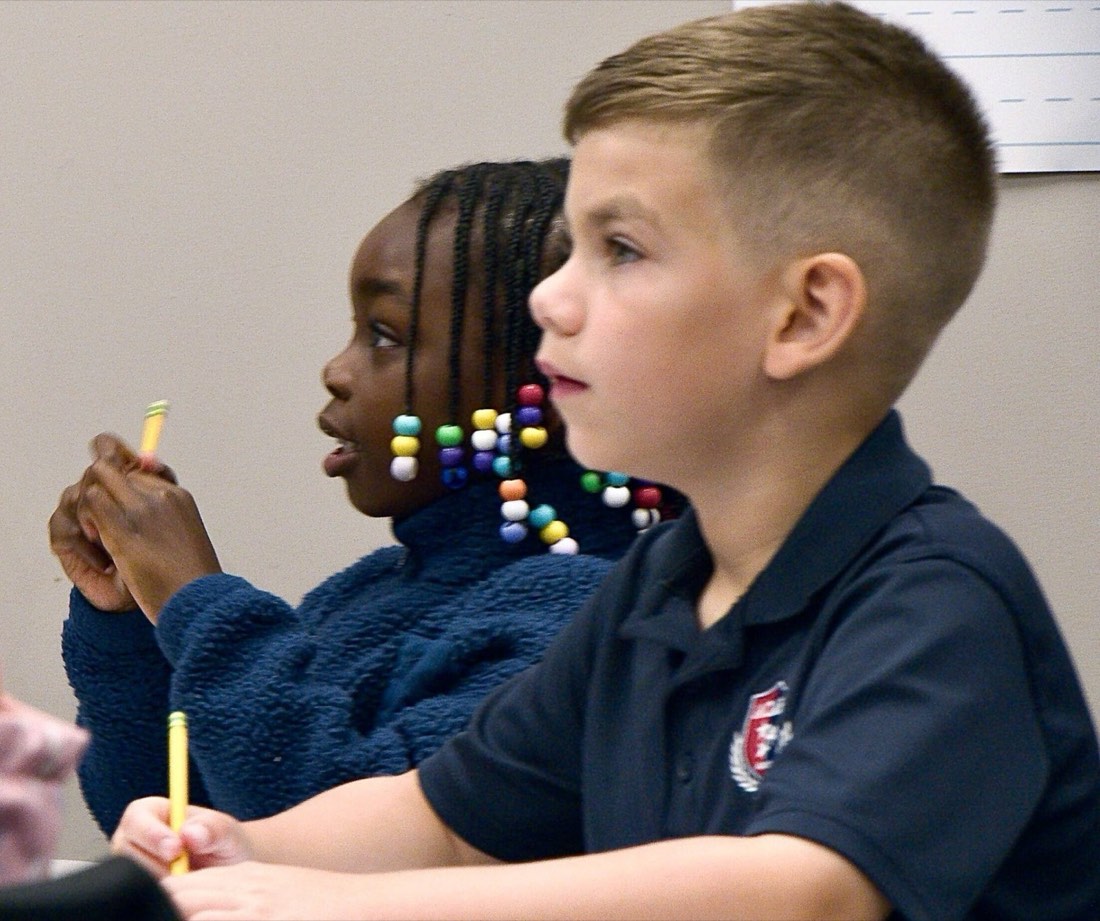
In a classroom this is less abstract than it sounds. A child is read books worth reading, asked questions they cannot answer by guessing, and expected to explain their reasoning out loud. They are taught by a teacher who knows the subject and leads the lesson, not by a worksheet. The aim at every stage is that a child can say why, and not only what.
None of that works without parents, and we do not pretend otherwise. A child who is read to at home, asked about their day, and expected to finish what they start arrives ready to learn in a way no school can manufacture on its own. So we ask parents to be the other half of this, and we try to make that possible rather than merely requested: conferences twice a year, curriculum nights, Coffee with the Head of School each month, and a shared summer reading list, so that the books a child meets in class are ones a family can talk about at the table.
What we are building, in the end, is a community rather than a service. Families serve on the Parent-Teacher Coalition, chaperone the trips, raise money for the things public funding does not stretch to, and come to conferences and curriculum nights. A school is finally a group of people who have agreed what is worth passing on to the next generation and have decided to do it together — which is why we would rather you were in the building than impressed by it.
03 — The Approach
The classical education approach
American Classical Academy Rutherford is built on the premise that if the aim of education is human happiness, we must structure our efforts on what is most conducive to achieving that end. That begins with understanding what happiness is and is not.
El propósito de este planteamiento es enseñar a los niños a pensar poniéndoles delante, en cada etapa del aprendizaje, modelos adecuados a su edad de cómo se debe buscar la verdad, el bien y la belleza, y animándoles así a desarrollar los mismos hábitos de curiosidad, humildad y reverencia en sus propios estudios.
This education, of course, is rigorous and challenging; and it is highly dependent on quality teaching. The success of the classical model shows that teachers and students are up to the task. By instilling a love of learning and teaching students how to think deeply and adeptly, the teacher passes on the priceless legacy of enabling another to respond with philosophic acuity to a variety of different challenges and opportunities in life.
04 — American
Why an American classical education
Our commitment at ACAR to classical education is furthered by our belief that we have a civic and patriotic duty to teach the founding principles of the United States, including constitutional government, individual liberty, and the rule of law. In instilling an understanding and appreciation of America’s unique political heritage, we better enable students to search for truth, goodness, and beauty, in all its unique complexity in American history.
American classical education centers on the study of the great books of Western civilization, including classical Greek and Roman texts, works of literature, philosophy, and political thought. This approach provides students with a deep and comprehensive understanding of the intellectual and cultural foundations of Western society.
A school like this is not built by a curriculum or a board. It is built by the families who decided it was worth the trouble and who keep showing up — on the Parent-Teacher Coalition, on the trips, behind the fundraising — to prove it.
So come and see what that looks like on an ordinary morning. Not a showcase and not an open evening: a normal school day, with Latin on the board and a class that will happily argue with you about it. The invitation is not a formality — the only way to understand a school is to stand in one.
Enroll Today
Give your child a classical education
Tuition-free, K–7, in Rutherford County. No cost and no entrance exam.