
Grades 6 and 7
Upper School
The years when a student stops gathering knowledge and starts reasoning with it — and discovers they have something worth saying.
01 — The Approach
What the Upper School is for
In the Grammar School, a child fills up: facts, poems, tables, stories, the shape of the world. The Upper School is where all of that starts being used. Students begin to argue — naturally and insistently, at this age — and classical education channels that rather than fighting it.
This is the logic stage of the trivium. Students learn how a sound argument is built and how to spot one that is not, and they are asked to defend what they think with reasons rather than assertion. It is more demanding than the grammar years, and students generally rise to it because they are finally being asked to.
02 — How It Is Taught
The shape of an Upper School day
-
Direct instruction
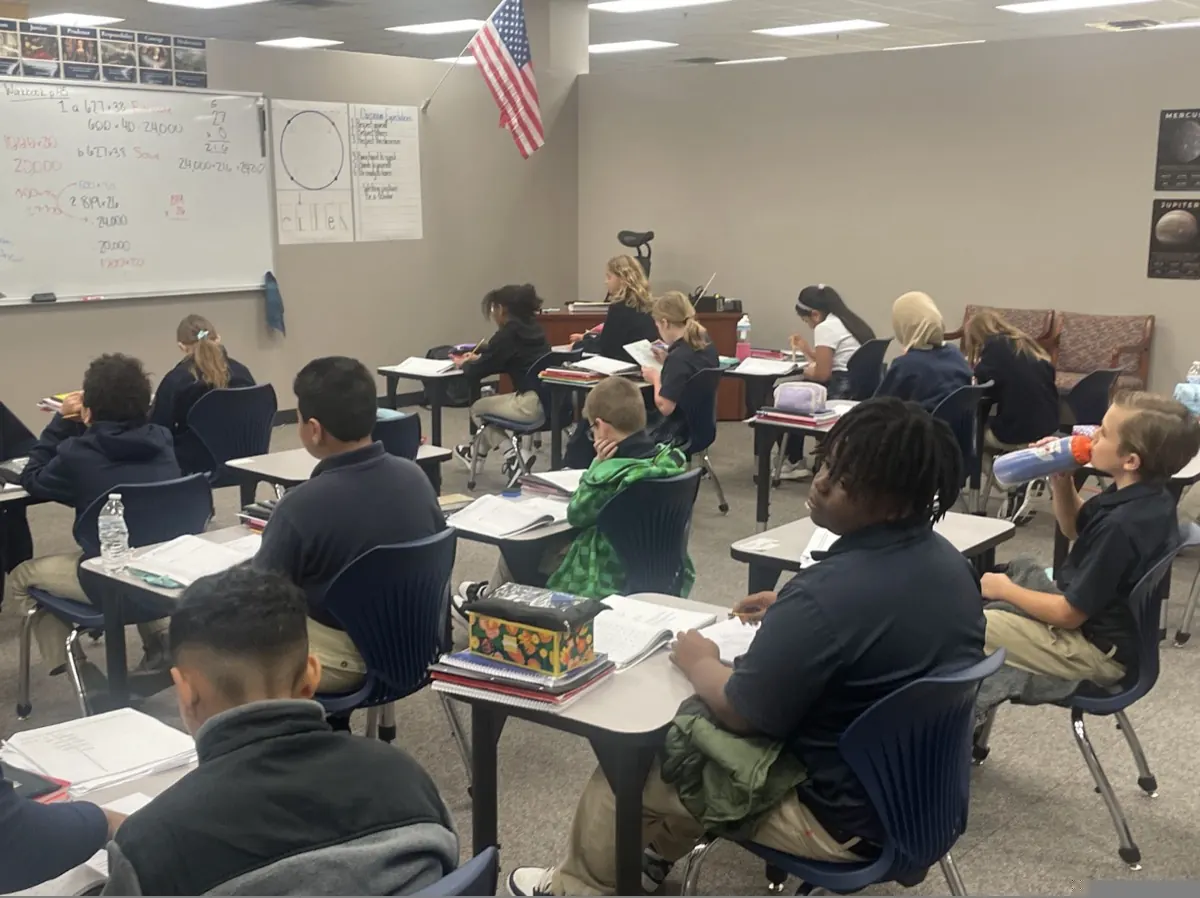
A teacher who knows the subject teaches it from the front. The room is calm and ordered, because sustained attention is what this work requires.
-
Socratic discussion
Much of the day is guided conversation. A teacher asks a real question, listens to a real answer, and asks again — drawing the reasoning out rather than delivering it.
-
Written work
Students write about what they have read, in their own words, defending a position. Writing is where loose thinking becomes visible.
-
Independent practice
Time to work alone at something difficult, which is a skill in itself and one high school will expect.
03 — By the End
The course of study
What grades 6 and 7 cover, subject by subject.
| Stage | What a student can do |
|---|---|
| Mathematics | Ratio and proportion, percentages, negative numbers and algebraic thinking, with reasoning written out in full. |
| Latin | Grammar, vocabulary and translation — and the roots of a great deal of English, which shows up everywhere else. |
| Literature | Demanding whole books, read closely and discussed rather than summarized. |
| History & Geography | The American founding and the wider Western story, worked from sources rather than only from a textbook. |
| Science | Observation, measurement and explanation, with the mathematics students already have put to work. |
| Composition & Rhetoric | Writing and speaking clearly, gracefully and persuasively. |
| Fine Arts & Music | Looking at and making real work, and singing and playing real music. |
| Physical Education | Movement, games and the habits of a healthy body. |
04 — A Worked Example
What reasoning sounds like here
Teacher: You say the character was right to break his promise. What makes that right rather than merely convenient?
Student: Because keeping it would have hurt someone who had done nothing wrong.
An assertion — now it has to be defended.
Teacher: Then is a promise binding only when keeping it costs nobody anything?
The student now has to refine the claim rather than repeat it. That refining is the work of these two years.
05 — What We Use
What these years ask of a student
- Whole books Read at home as well as in class, and discussed on the assumption they were read.
- Written argument Regular writing in which a position is taken and defended.
- Daily preparation Homework that is genuine practice rather than busywork, and that a student is expected to manage themselves.
At this age they will argue with you about anything. The trick is to teach them to argue well.
ACAR Teacher
06 — Progress
How we know it is working
Teachers assess continuously through discussion and written work — a student defending a position is the real measure — alongside unit assessments in each subject. Report cards describe what a student can do and where they are stretching, and a teacher will always talk you through it.
07 — At Home
How to help at home
-
Ask what they disagreed with
A better question than “what did you learn.” It gets at whether they were thinking.
-
Let them defend a position at dinner
Push back gently. Being asked “why do you think that” by someone who is listening is the whole method.
-
Protect the reading time
These years ask for whole books. A quiet half hour matters more than any worksheet.
08 — Common Questions
What families ask
What happens after grade 7?
Students move on to high school. Our aim is that they arrive able to read a hard book, write a clear argument and do mathematics they understand — which is what every good high school is looking for.
How does this prepare a student for high school?
By asking for the habits high school assumes: sustained attention, work managed independently, and the ability to defend an idea in writing. Students who have done these two years are generally ahead on exactly those.
How much homework is there?
Enough to practice what was taught and to read what is being discussed, and not more. If homework is regularly taking far longer than it should, tell the teacher — that is information they want.
Enroll Today
Give your child a classical education
Tuition-free, K–7, in Rutherford County. No cost and no entrance exam.